
Description
Tessera is a developer library for plugin authors who register abilities via wp_register_ability() and want snapshot capture, audit logging, approval workflows, and one-click rollback for every invocation across REST, MCP, internal PHP, and WP-CLI without building it themselves.
Declare what state your ability touches; Tessera handles the safety wrapper.
What you get out of the box
- Pre + post snapshots. Every safety-enabled invocation captures declared state before the callback and (on success) after, so the audit log can show a real diff.
- Audit log. One row per invocation with ability name, caller (REST/MCP/CLI/internal), user, args, result, status, duration, pre/post hashes, and parent_invocation_id for nested calls.
- One-click rollback. Restore captured state from post_meta, options, taxonomy term assignments, user roles + caps. File contents support tiered drift detection (mtime / mtime_size / critical_hash / full_hash) plus opt-in real byte-level rollback via
full_contentstrategy. - Drift check on rollback. Live state is hashed and compared to the snapshot’s post-state before restoring; if they differ the rollback returns an error unless forced.
- Concurrency lock. Capture + execute is serialised per surface set via a MySQL advisory lock so two simultaneous invocations do not capture each other’s mid-states.
- Encrypted redaction. Scrub secrets out of args, results, and snapshots. Stores redacted values as AES-256-GCM envelopes so rollback can still restore them.
- Approval queue. When
safety.requires_approvalis set, the wrapper blocks execution and returns a 202 pending response. A human approves or rejects via wp-admin, WP-CLI, or REST. Multi-stage sequential or parallel approval chains are supported. - Multisite support. Each subsite gets its own set of
wp_<N>_abilityguard_*tables, with auto-install onwp_initialize_siteand auto-drop onwpmu_drop_tables. - Retention. Daily WP-Cron prunes old log rows (defaults: 30 days normal, 180 days destructive) and orphaned snapshots.
Surfaces
- PHP API with
wp_register_ability( $name, [ ..., 'safety' => [...] ] )and helpersabilityguard_rollback,abilityguard_snapshot_meta,abilityguard_snapshot_options. - REST:
/abilityguard/v1/log,/log/<id>,/log/export,/rollback/<id>,/rollback/bulk,/approval,/approval/<id>/approve,/approval/<id>/reject,/approval/bulk,/approval/export,/retention,/retention/prune,/health. - WP-CLI:
wp abilityguard log list/show,wp abilityguard rollback <id>,wp abilityguard approval list/approve/reject <id>,wp abilityguard prune. - wp-admin: Tools > Tessera. Hybrid timeline + command-palette search, snapshot drawer, JSON-highlighted Input/Result tabs, invocation chain navigation, and real rollback against the captured snapshot.
Example
wp_register_ability( 'my-plugin/update-product-price', array(
    'label'               => 'Update product price',
    'description'         => 'Updates the price on a WooCommerce product.',
    'category'            => 'woocommerce',
    'input_schema'        => array( /* ... */ ),
    'permission_callback' => fn() => current_user_can( 'manage_woocommerce' ),
    'execute_callback'    => fn( $args ) => update_post_meta( $args['product_id'], '_price', $args['price'] ),
    'safety' => array(
        'destructive'       => true,
        'requires_approval' => false,
        'snapshot'          => fn( $input ) => array(
            'post_meta' => array( $input['product_id'] => array( '_price', '_regular_price' ) ),
            'options'   => array( 'woocommerce_last_price_change' ),
        ),
    ),
) );
Documentation
Full plugin-author documentation lives at the GitHub repo: https://github.com/ibrahimhajjaj/abilityguard
Source Code
The full source for Tessera, including the unminified React source for the admin app, lives on GitHub: https://github.com/ibrahimhajjaj/abilityguard
- The admin bundle
assets/admin.jsis compiled fromassets/admin.jsx(React + JSX, no preprocessor magic beyond JSX). - The bundler is esbuild, configured in
scripts/build.mjs. - To rebuild the admin bundle from a fresh checkout, run
npm installonce, thennpm run buildwheneverassets/admin.jsxchanges. This regeneratesassets/admin.jsin place. - The release zip published to the WordPress.org directory is produced by
scripts/build-release.sh, which excludes development artifacts (tests, examples, build configs) but keeps everything required for the plugin to run.
Screenshots
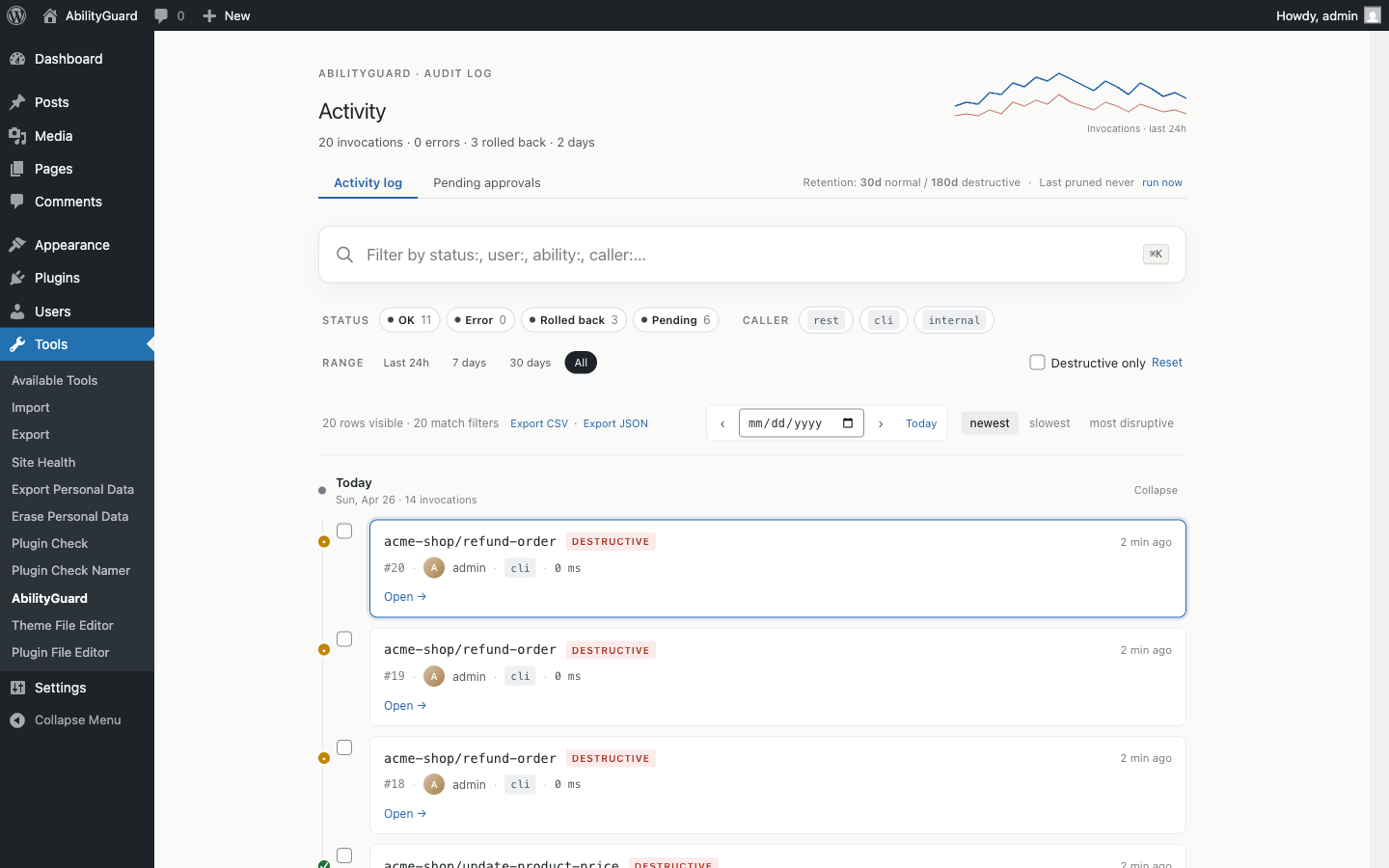
Invocation timeline. Every ability call across REST, MCP, internal PHP, and WP-CLI, with caller attribution and per-row status. 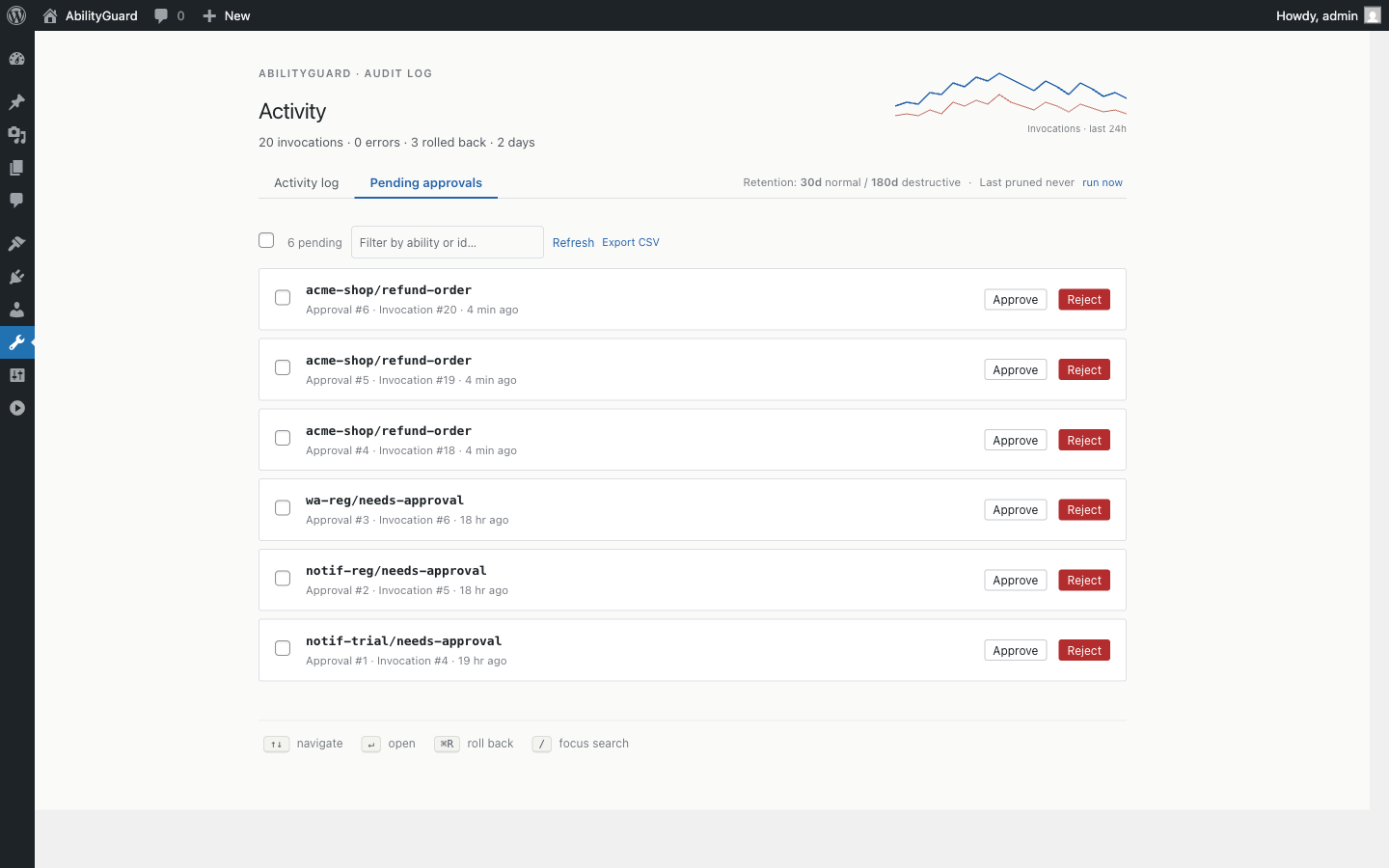
Approvals queue. Pending requests waiting on a human, with the requesting context and a one-click approve or reject. 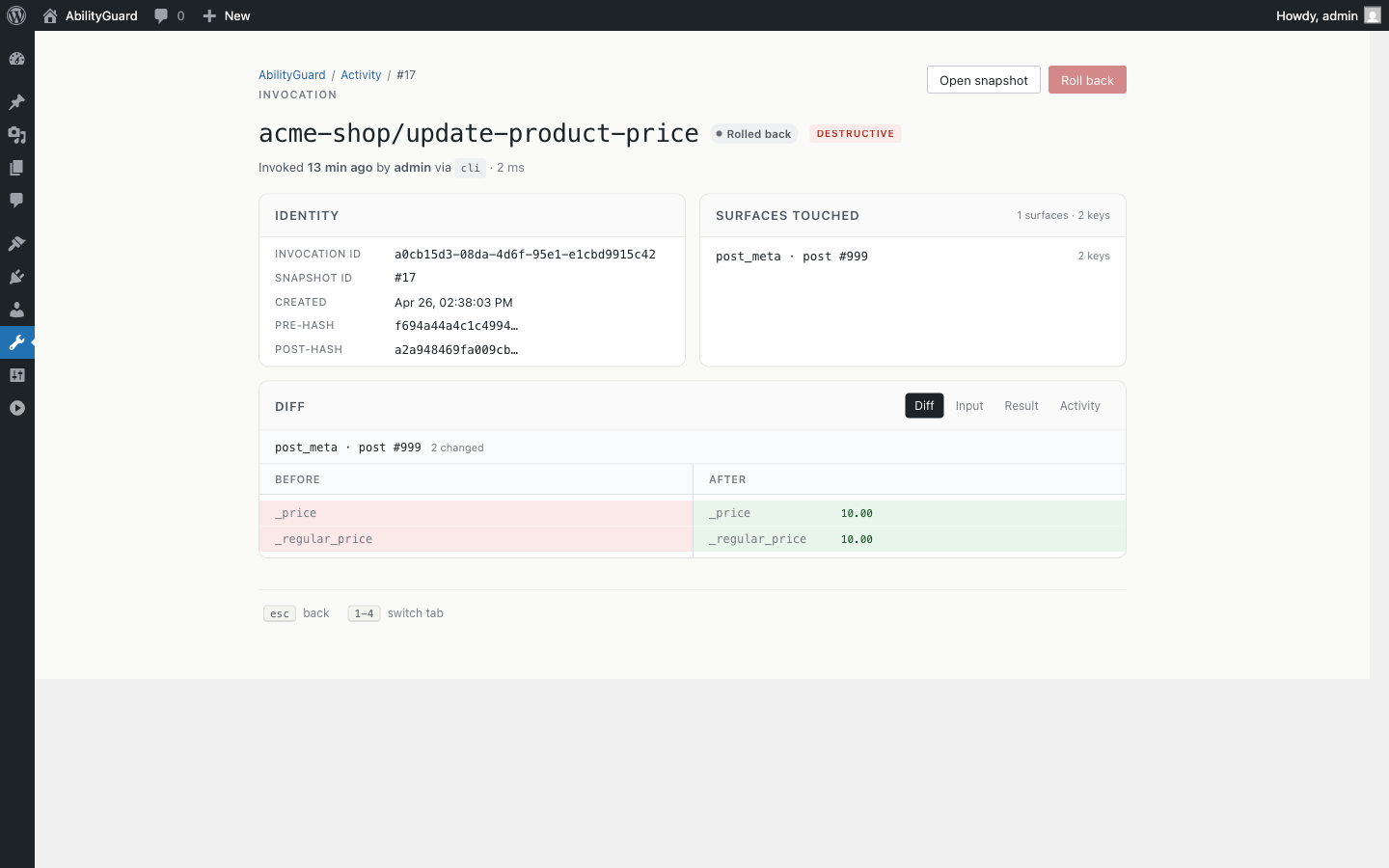
Invocation detail after a one-click rollback restored the captured pre-state. 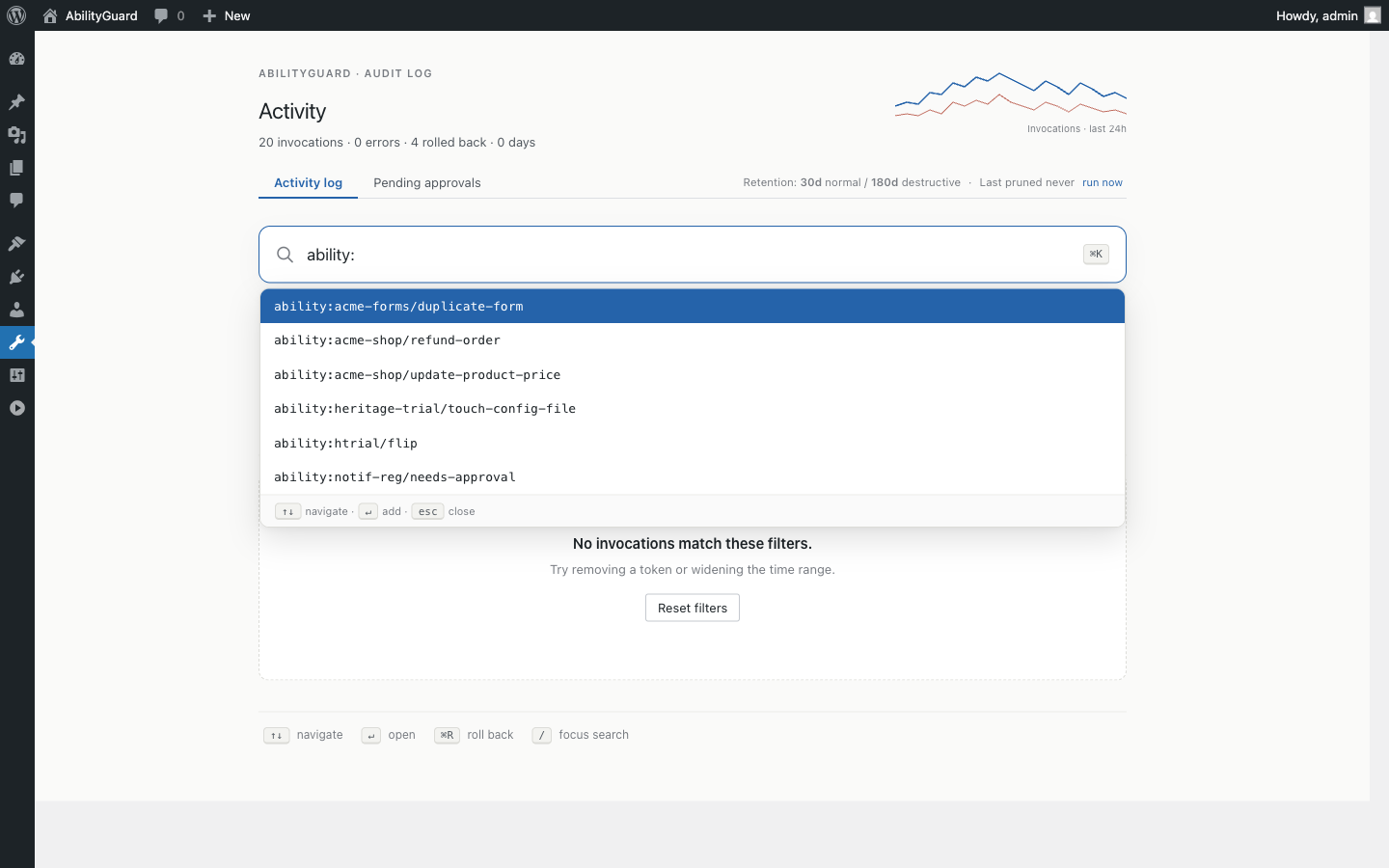
Search-as-you-type in the log: ability name, caller, status. 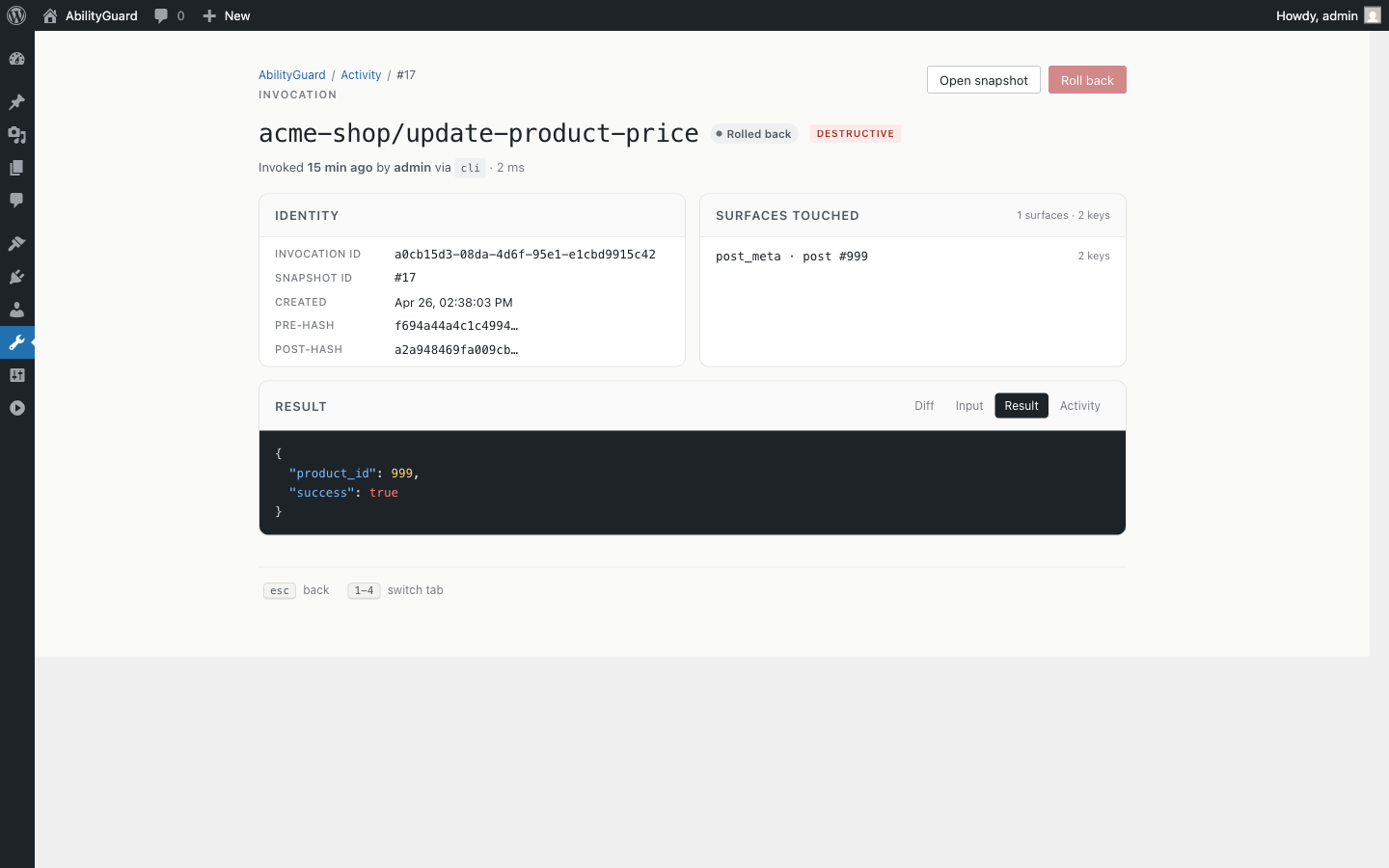
Invocation detail, result tab, with redacted secret values restored on display when the encryption key is present. 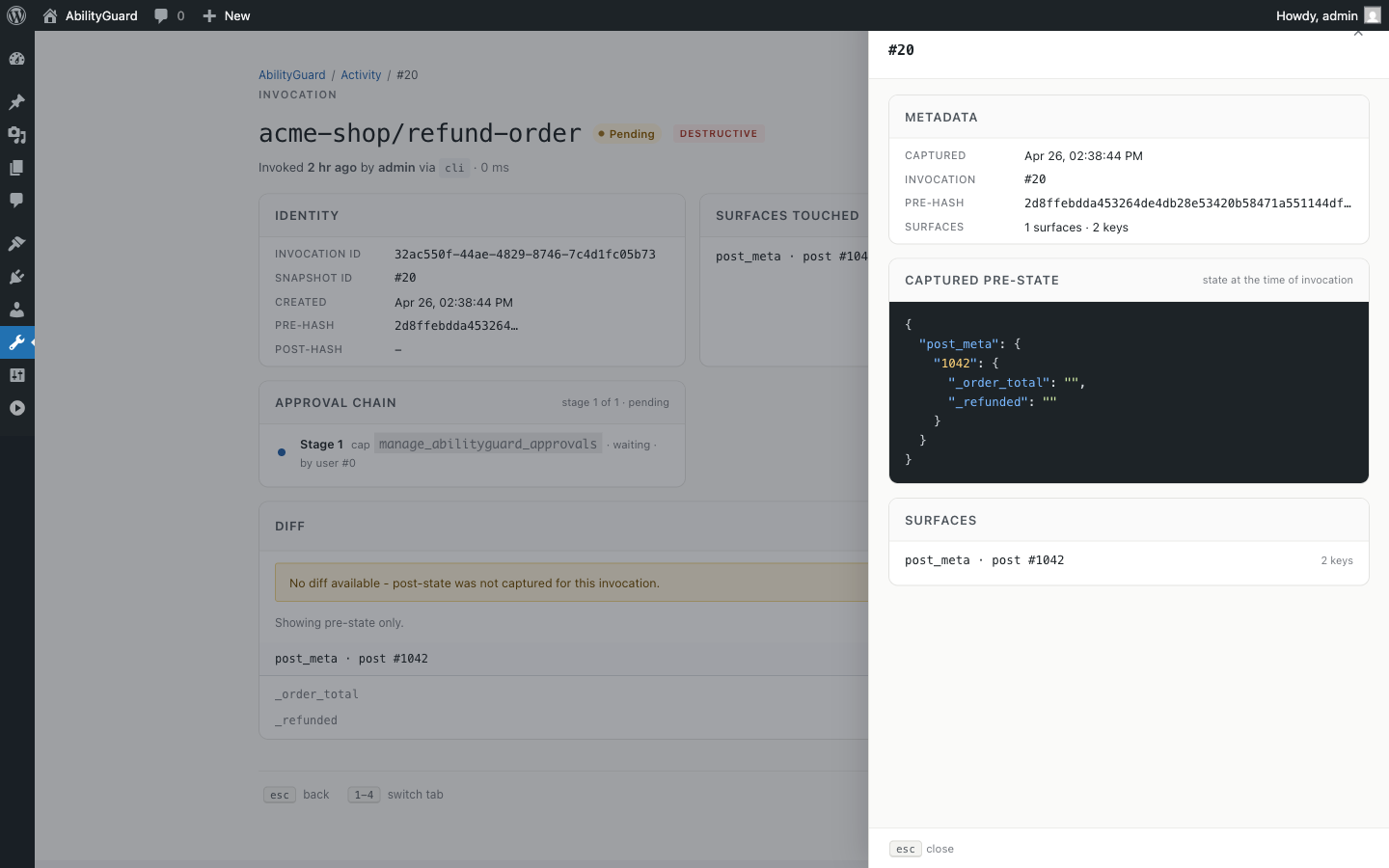
Snapshot drawer showing the captured pre-state and post-state for a destructive invocation. 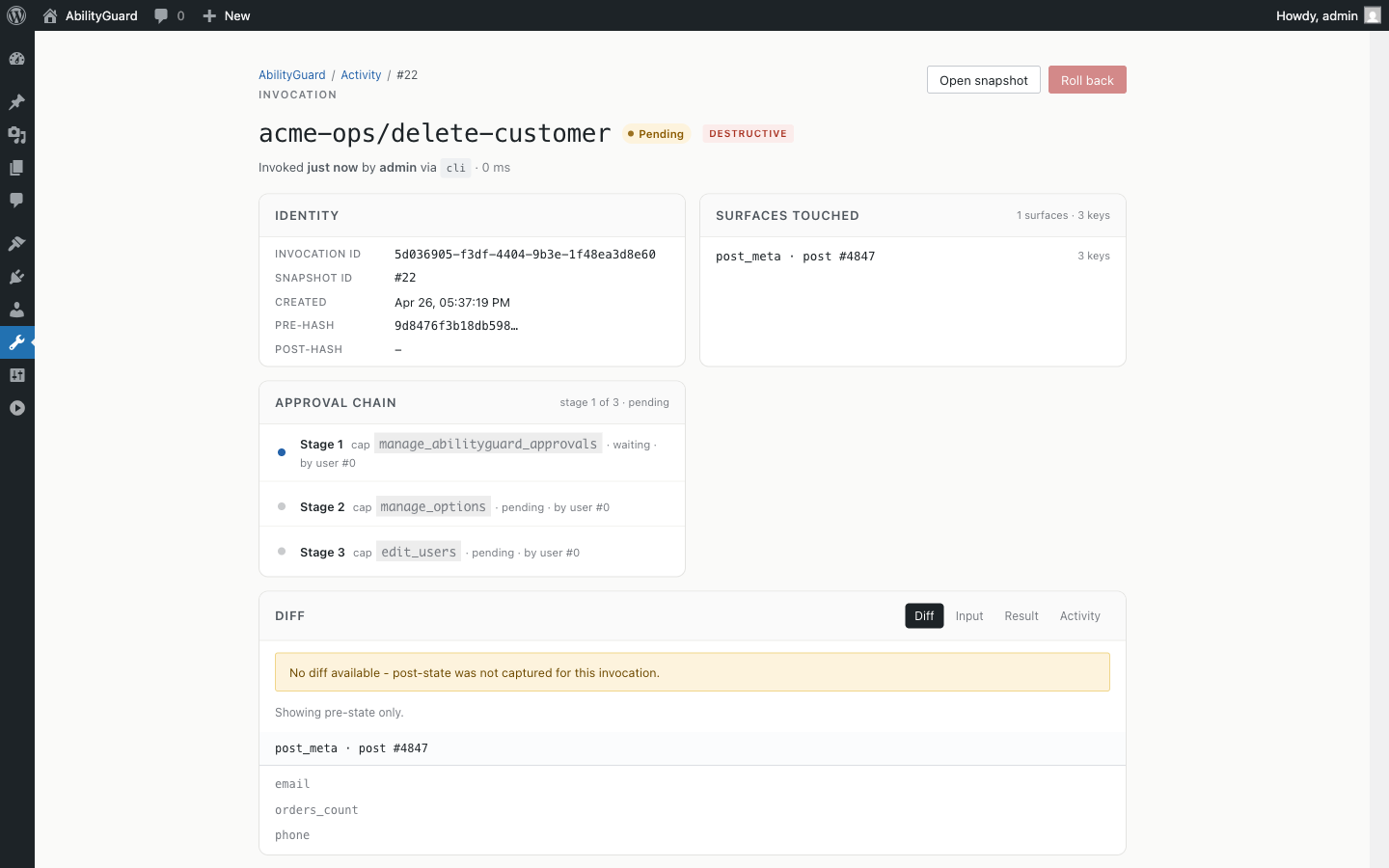
Multi-stage approval chain with per-stage capability and role routing.
Installation
- Upload the
abilityguard-mcpfolder to/wp-content/plugins/. - Activate the plugin through the Plugins menu in WordPress (or network-activate on multisite).
- Visit Tools > Tessera to view the audit log.
- In your own plugin, register abilities via
wp_register_ability()with asafetyconfig.
Requires WordPress 6.9 or later (for the Abilities API) and PHP 8.1 or later.
FAQ-e
-
Does this work without other plugins?
-
It will activate without registered abilities, but it only does work when other plugins register abilities with a
safetyconfig viawp_register_ability(). -
What state surfaces are supported for snapshots?
-
post_meta, options, taxonomy term assignments, user roles + caps, and files (with five tiered strategies from mtime to full content rollback).
-
Does it support multisite?
-
Yes. Each subsite gets its own set of
wp_<N>_abilityguard_*tables. New subsites are auto-installed viawp_initialize_site; deleted subsites have their tables dropped viawpmu_drop_tables. -
How does it handle concurrent invocations?
-
Per-surface MySQL advisory locks (GET_LOCK) serialise capture + execute so simultaneous invocations do not capture each other’s mid-states.
-
Are secrets encrypted in the log?
-
Yes. Redaction uses AES-256-GCM envelopes so rollback can still restore the original value when the encryption key is intact.
Reviews
There are no reviews for this plugin.
Contributors & Developers
“Tessera for the Abilities API” is open source software. The following people have contributed to this plugin.
Contributors
Translate “Tessera for the Abilities API” into your language.
Interested in development?
Browse the code, check out the SVN repository, or subscribe to the development log by RSS.
Changelog
1.3.5
- Release zip no longer ships
composer/installersand its unused installer adapters. Cuts the published zip from 909K to 824K and 206 files to 98.
1.3.4
- Release zip now ships
vendor/autoload.phpso the plugin actually boots on a fresh install. (1.3.3 zip was missing the autoloader and fatal’d on activation.)
1.3.3
- Display name changed to “Tessera for the Abilities API” to clearly distinguish this plugin from any future official safety library. Slug, text domain, and internal namespace are unchanged.
error_log()calls in the rate-limiter and concurrency lock are now gated behindWP_DEBUG, so production hosts no longer accumulate noise from fail-open paths.readme.txtgains a Source Code section documenting the GitHub repository, the esbuild-based build pipeline, and thenpm run buildcommand used to regenerateassets/admin.js.
1.3.2
- Slug renamed to
abilityguard-mcpfor the WordPress.org directory. - Snapshot file blobs now stored under
wp-uploads/abilityguard-mcp/instead ofwp-content/abilityguard-staging/. - Admin page CSS folded into the existing enqueued bundle; no more inline
<script>/<style>echoes. $_SERVER['REMOTE_ADDR']is unslashed and sanitized before being hashed for IP-keyed rate-limit principals.
1.3.1
- Skipped (broken release-workflow build).
1.3.0
- Sliding-window-counter rate limiter with multi-policy support (burst + sustained), pluggable storage (Redis / object cache / transient), and IETF draft RateLimit headers.
- Dry-run mode: per-call
safety.dry_runpreviews a destructive ability, persists the diff, auto-rolls-back, and surfaces details via/dry-run/<id>REST endpoint andabilityguard_get_dry_run_result()helper. Result returns untouched so it validates againstoutput_schema. - Approval queue gains per-stage role routing (
approval_roles) and separation-of-duties enforcement across the chain. - Per-status retention via
abilityguard_retention_days_by_status. /statsREST endpoint and admin dashboard widget (counts, p50/p95, top abilities).- Wrapper split into observability listeners on
wp_before_execute_ability/wp_after_execute_abilityplus an enforcement seam (abilityguard_pre_execute_decisionfilter) for plugin extensions. - Reads
meta.annotations.destructivedirectly from core (WP 6.9 surface), no parallel safety metadata. - Requires WP 6.9; pre-6.9 fallback path removed.
1.2.0
- Parallel multi-stage approval chains with optional per-stage user pinning.
/healthREST endpoint and a pending-approvals badge in the admin bar.- WP-CLI:
log show --diff,approval show,prune --all-sites. - JSONL export option for audit log.
- Real byte-level file rollback via
safety.snapshot.files.strategy = 'full_content'(AES-256-GCM, content-addressed sidecar staging dir, atomic writes, 256 KB per-file cap). - Full multisite support with auto-install on subsite creation and auto-drop on subsite deletion.
- Sequential and parallel multi-stage approval chains.
1.1.0
- Multi-stage approval queues.
- Invocation correlation via
parent_invocation_idand an admin-side invocation chain navigator. log_metatable for extensible per-row metadata.
1.0.0
- Initial public release.
- Snapshot, audit, rollback, and approval middleware for the WordPress Abilities API.
- Five collectors: post_meta, options, taxonomy, user_role, files.
- REST + WP-CLI + wp-admin surfaces.
- Encrypted redaction, payload caps, retention pruning.